


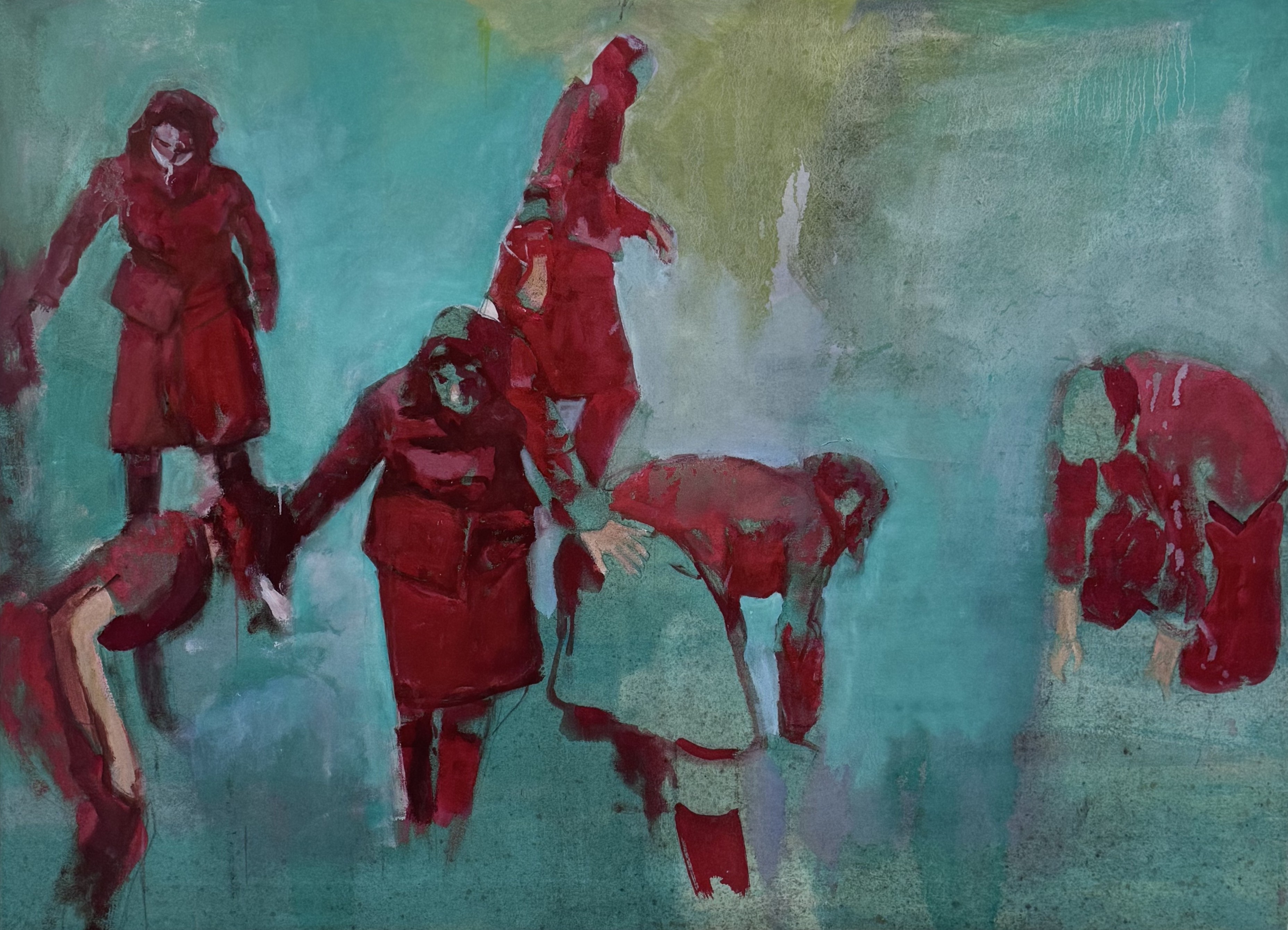
Crispin Dior paints with the perspective of an artist grounded in lived experience, shaped by years of creative exploration. His work feels restless, self-described as “autobiographical”, his product is one of a practice shaped not by art school linearity, but by interruption, reinvention and instinct. After an early passion in art, but a lack of contentment at Norwich School of Art Crispin found himself moving away from the brush and towards the instruments with careers in music and as an electrician. A few decades later, painting found its way back to Crispin as the only place where things “made sense”. A space for creative discovery emerged once again. This time he wanted to find his vocabulary, through constant experimentation he discovered something that resonated with him.
His work moves between figuration and abstraction, built through layers of colour and rhythm with a unique process of letting his instincts take control. This allows his inspiration to explore imperfections in his work and really emphasise the improvisational methods behind his final result.
Crispin’s instinctive approach sits at the centre of how each painting unfolds. He begins with movement rather than a plan, letting marks land before he understands what they might become. He talks about starting as “attacking the canvas”. It isn’t aggression, just the willingness to begin without certainty. That first impulsive act pushes the painting forward and forces him into discovery rather than control.
Works often pass through several states. He will scrape sections back, repaint, or rework entire compositions if something loses energy. Accidents stay active in the painting for as long as they feel alive. He once said, “I want to celebrate the accidents”, and it isn’t a casual throwaway. His process depends on it.
These choices accumulate in the surface. There is a physical memory in the paint. Areas thicken, others thin out, older passages sit underneath fresh ones, and the result is a surface that feels worked rather than arranged. He compares elements like this to “weathered doors” that acquire presence through exposure and time rather than precision. Nothing in these paintings appears processed. They feel lived in.
Music sits there too, even though he rarely listens while working. It is part of how he judges rhythm, tension, and contrast. He said he often feels like he can “almost hear music” when he paints. It shows in the work. Figures lean, colours respond to each other, shapes shift into balance. He paints like someone responding rather than placing.
“Sometimes everything goes wrong — that’s part of the excitement.”
Drawing still grounds everything. He treats it as rehearsal rather than preparation. The recent ink drawings he made with a block of metal force awkward movement into the line. They stop him tidying, which he values. He said he doesn’t want paintings to feel “perfect” because life isn’t perfect. This keeps the work open. Mistakes are not obstacles, they are invitations.
Identity threads its way in quietly. Faces appear and dissolve. Hands take shape then recede. Nothing is fully explained. He once said painting was the only place where things “made sense” growing up, and that connection seems to remain. It isn't an autobiography in the literal sense. It is memory resurfacing as form.
That is why every new piece feels significant for him. The latest painting isn’t better than the last, it is simply where the work currently speaks. He said, “These are still baby steps” which is revealing. Not modesty, but awareness that he is still early in his painter’s life. A few decades passed before painting found its way back to him, so the return carries urgency.
What his paintings hold is a point of tension: the moment before something settles. You can see marks that nearly commit then shift away. A figure forms then fades. Colour almost stabilises then breaks. They are paintings that ask to be discovered rather than decoded. The work is not presenting answers. It is presenting the point just before answers arrive.
That is where Crispin is most himself. The result feels immediate and unguarded, driven more by instinct than certainty. The paintings are not resolved in a neat conclusion. They remain open enough to breathe, and in that space they reveal something honest.